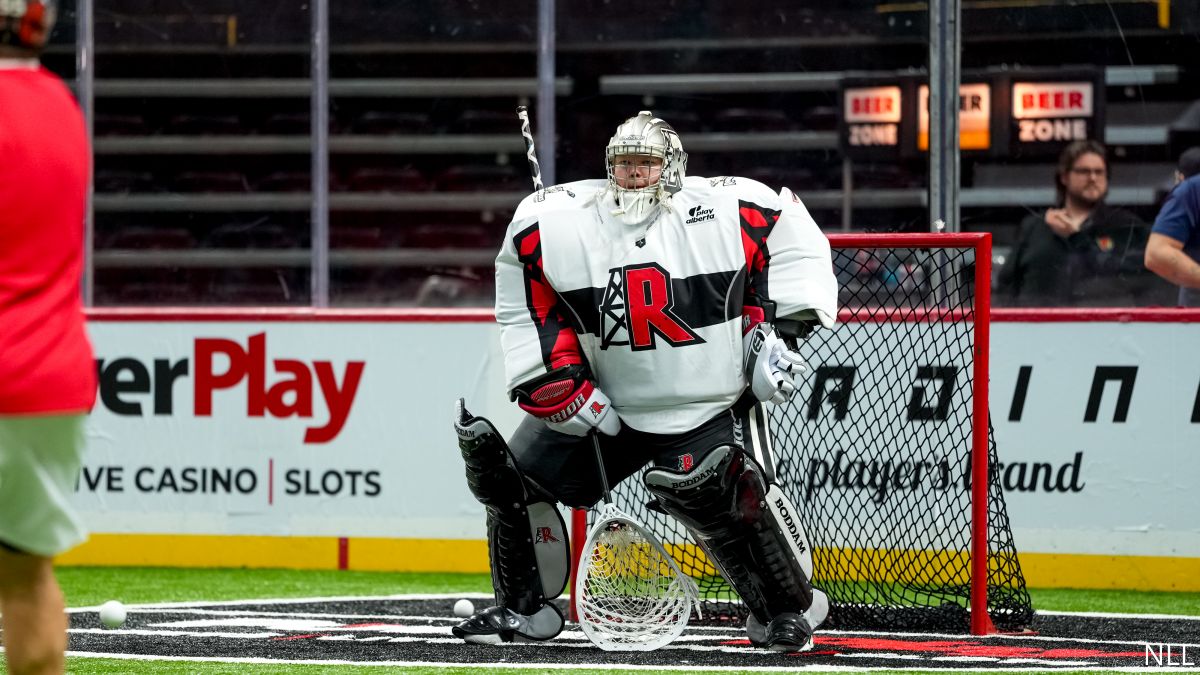
Box lacrosse and field lacrosse share the same basic objective — move the ball with a stick and score in the opponent’s goal — but the games look and play very differently. National Lacrosse League box lacrosse is played indoors with six players per team, boards, smaller goals and a 30-second shot clock, while NCAA men’s field lacrosse is played outdoors with 10 players per team on a much larger field.
Those differences affect nearly everything a fan sees, from substitutions and possessions to physical contact and how the ball goes out of bounds.
What Is The Difference Between Box Lacrosse And Field Lacrosse?
The biggest differences between NLL box lacrosse and NCAA men’s field lacrosse are the playing area, number of players, goal size, possession clock and boundaries.
NLL box lacrosse is played on an indoor artificial surface surrounded by boards and glass. Six players per team are permitted on the floor, and the goals measure 4 feet, 9 inches wide by 4 feet high.
NCAA men’s field lacrosse is played outdoors on a 110-by-60-yard field. Each team has 10 players, and the goals measure 6 feet by 6 feet.
Both formats play four 15-minute quarters for 60 minutes of regulation.
How Many Players Are In Box Lacrosse vs. Field Lacrosse?
NLL box lacrosse has six players per team on the floor, while NCAA men’s field lacrosse has 10 players per team.
The six NLL players normally consist of five runners and one goalkeeper. Teams can remove the goalkeeper for another runner, but that replacement does not receive goalkeeper privileges.
Field lacrosse does not always have 10 players. NCAA women’s field lacrosse uses 12 players, including the goalkeeper.
How Are Box Lacrosse And Field Lacrosse Playing Areas Different?
NLL box lacrosse is played indoors inside boards and glass, while NCAA men’s field lacrosse uses an outdoor field with sidelines and end lines.
That changes how the ball behaves. In the NLL, the boards generally are live, so a pass or shot can ricochet off them and remain in play. In field lacrosse, the sidelines and end lines establish traditional out-of-bounds boundaries.
NLL arenas also can have arena-specific dimensions, so not every professional box lacrosse floor should be described as exactly the same size.
How Are Box Lacrosse And Field Lacrosse Shot Clocks Different?
The NLL uses a 30-second shot clock, while NCAA men’s field lacrosse uses an 80-second possession clock with 60-second offensive resets.
In NCAA men’s lacrosse, a team gaining possession must advance the ball across midfield while 60 seconds remain on the 80-second clock. Qualifying retained shots in the offensive half can reset the clock to 60 seconds.
NCAA women’s lacrosse uses a separate 90-second possession clock, with defined situations that can reset it to 60 seconds.
The NLL’s shorter clock helps create quick, compact offensive possessions.
How Are Positions Different In Box Lacrosse And Field Lacrosse?
NCAA men’s field lacrosse uses attack, midfield, defense and goalie as its familiar positional structure, while NLL box lacrosse has one designated goalkeeper and five runners who fill more fluid tactical roles.
NCAA men’s teams also commonly use specialists such as long-stick midfielders, faceoff specialists and short-stick defensive midfielders.
NLL runners commonly are described as forwards, transition players and defensemen. Those are strategic roles, however, rather than rules requiring teams to use a certain number of each.
How Do Substitutions Differ In Box Lacrosse And Field Lacrosse?
NLL box lacrosse features frequent on-the-fly substitutions, often with groups of runners changing as possession changes.
That can look similar to hockey-style line changes. Offensive players can leave as possession changes while defensive runners enter, with the process reversing when their team regains the ball.
Field lacrosse also permits on-the-fly substitutions through its substitution area. Live substitutions are not unique to box lacrosse, but the NLL’s smaller playing area and 30-second shot clock make frequent changes especially noticeable.
Is Box Lacrosse More Physical Than Field Lacrosse?
NLL box lacrosse permits a high level of physical contact, including specifically defined forms of legal cross-checking. That does not mean all cross-checking is legal.
NLL players can cross-check an opponent with possession under specified conditions, including restrictions on where contact can be delivered. Contact above the shoulders, below the waist or from behind is illegal.
NCAA men’s field lacrosse permits defined body checking, but cross-checking an opponent is a personal foul.
NCAA women’s field lacrosse has a different contact framework built around controlled stick checking and women-specific safety rules.
How Are The Goals And Creases Different In Box And Field Lacrosse?
NLL box lacrosse uses smaller goals than NCAA field lacrosse and has its own crease rules around the goal.
An NLL goal measures 4 feet, 9 inches wide by 4 feet high. NCAA men’s and women’s field goals measure 6 feet by 6 feet.
Both formats protect an area around the goalkeeper, but the crease rules are different. In the NLL, attackers face restrictions on entering the crease with the ball, although their sticks can extend into it. A shooter also can enter the crease after releasing the ball in certain circumstances, making the timing of the shot and crease contact important.
Is Box Lacrosse Faster Than Field Lacrosse?
NLL box lacrosse generally creates shorter and more compressed possessions because of its 30-second shot clock, enclosed playing area, live boards and frequent substitutions.
NCAA field lacrosse spreads more players across a larger playing surface and provides longer possession-clock structures.
The result is a noticeable difference in pace and spacing, though those are strategic consequences of the rules rather than separate rules themselves.
What Will Field Lacrosse Fans Notice First About Box Lacrosse?
Field lacrosse fans watching the NLL for the first time will immediately notice fewer players, smaller goals, shorter possessions, live boards and frequent substitutions.
The physical contact also looks different, particularly the NLL’s rules governing legal cross-checking.
The easiest way to follow the game is to watch the 30-second shot clock and possession changes. Once the boards, substitutions and crease rules become familiar, many of the biggest differences between NLL box lacrosse and field lacrosse become easier to recognize.
Frequently Asked Questions About FloLacrosse
What Do You Get With A FloLacrosse Subscription?
A FloLacrosse subscription combines live lacrosse with replays and year-round coverage of the sport.
The NLL gives subscribers a season-long professional box lacrosse property to follow, while FloLacrosse also carries additional college, high school and event programming. Beyond streaming, fans can use FloLacrosse for rankings, recruiting coverage, scores, schedules, highlights, interviews, news and analysis, creating a destination for following lacrosse rather than simply finding a stream on game day.
What Can You Watch On FloLacrosse?
FloLacrosse subscribers can watch professional lacrosse through the National Lacrosse League, along with additional college, high school and event coverage available on the platform.
The NLL significantly expands that offering by providing a professional league fans can follow across an entire season. FloLacrosse's broader schedule also features field and box lacrosse at multiple levels, though specific event availability can vary by competition and streaming rights.
Can You Watch The NLL On FloLacrosse?
Yes. The National Lacrosse League streams on FloLacrosse as part of FloSports' partnership with the NLL.
That makes professional box lacrosse one of the biggest reasons for lacrosse fans to consider a subscription. Fans can follow NLL teams, players and games throughout the season while using FloLacrosse's broader coverage to keep up with the league and the sport.
Can You Watch Lacrosse Live And On Demand On FloLacrosse?
Yes. FloLacrosse provides live streams and on-demand replays for supported lacrosse programming.
That gives fans flexibility to watch games live or return to available broadcasts afterward. Subscribers also can watch through supported FloSports apps and connected devices, making it easier to follow lacrosse throughout a busy weekend or season.
Does FloLacrosse Have Scores, Schedules And Results?
Yes. FloLacrosse provides schedules, scores, results and other competition information alongside its video and editorial coverage.
These resources help fans track upcoming games and completed events while following leagues, teams and tournaments throughout the season.
Is A FloLacrosse Subscription Worth It?
FloLacrosse provides the most value to fans who want to follow lacrosse across multiple levels. The addition of the NLL strengthens that offering with season-long professional box lacrosse, while college, high school, recruiting and event coverage provides additional ways to follow the sport. Live games, replays, rankings, scores, recruiting coverage and original reporting extend the platform's usefulness beyond individual broadcasts.
How Do I Sign Up For FloLacrosse?
Fans interested in subscribing can visit the official FloLacrosse signup page to see current subscription options and sign up for access to available NLL games and other live and on-demand lacrosse programming.
What do you get with a FloLacrosse subscription?
Subscribers get supported live lacrosse and replays, including NLL coverage, plus rankings, recruiting coverage, schedules, scores, results, highlights, news and analysis.
Can you watch the NLL on FloLacrosse?
Yes. FloSports is an NLL streaming partner, giving FloLacrosse subscribers access to National Lacrosse League coverage as part of the platform's professional lacrosse offering.
What lacrosse can you watch on FloLacrosse?
FloLacrosse features professional box lacrosse through the NLL along with currently available college, high school and other lacrosse competitions.
Can you watch FloLacrosse on demand?
Yes. Supported games and events are available for replay, allowing subscribers to catch up on lacrosse they could not watch live.